
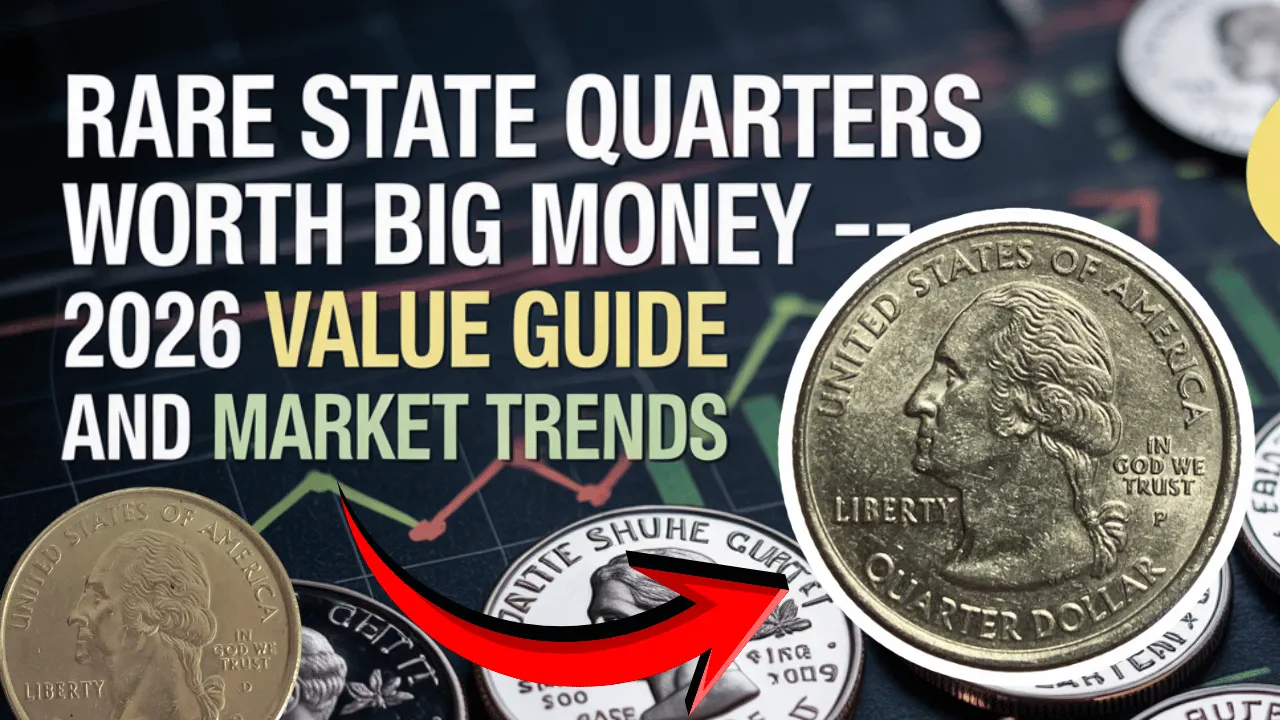
In 2026, interest in rare U.S. state quarters remains strong among collectors and investors. While most state quarters from the 1999–2008 series are common and worth face value, specific errors, low-mintage varieties, and high-grade examples can be worth significantly more — sometimes hundreds, thousands, or even tens of thousands of dollars.
This guide breaks down which state quarters are worth attention, how condition and errors impact value, and what collectors should know about the current market trends.
Why Some State Quarters Are Worth Big Money
State quarters were minted in massive quantities — over 34 billion coins between 1999 and 2008 — so most are inexpensive today. However, a small number of them are valuable due to:
- Minting errors (striking anomalies, doubled dies, off-center, broadstrikes)
- Low survival rates in high grade
- Unusual planchet or metal composition
- Certified high grades (MS67+, PR70)
- Collector demand and auction results
In coin collecting, rarity + condition + demand = value.
How Coin Value Is Determined
Before we look at specific coins, here are the main factors that influence market value:
1. Condition / Grade
Coins are graded from Poor (P-1) to Mint State (MS60–MS70) or Proof (PR/PGS). Higher grades with original luster and no wear command higher prices.
2. Errors and Varieties
Striking errors and unusual varieties — like doubled dies or off-center strikes — can dramatically increase value.
3. Mint Mark and Mintage
Coins from certain mints (Philadelphia “P”, Denver “D”, San Francisco “S”) and low-production years can be more valuable.
4. Market Demand
Collector trends, auction sales, and rarity all shape the current valuation environment.
2026 Rare State Quarters Value Chart
The chart below summarizes state quarters collectors pay attention to. Values are approximate retail/auction trends as of 2026 and depend heavily on grade and certification.
| State / Variety | Why It’s Valuable | Common Value Range |
|---|---|---|
| 1999-P Delaware MS68+ | High grade rarity | $150–$1,200+ |
| 2004-D Wisconsin Extra Leaf High | Known die variety | $100–$1,000+ |
| 2005-P Minnesota Doubled Die | Striking error | $500–$3,000+ |
| 1999-S Proof with FS701 Die Chip | Proof die variety | $200–$2,000+ |
| 2007-P Rhode Island Broadstrike | Striking anomaly | $1,000–$8,000+ |
| 2008-P Connecticut FS503 Punch Error | Rare planchet punch error | $500–$5,000+ |
| High-Grade PR70 DCAM Quarters | Rare perfect proof | $100–$500+ |
MS = Mint State; PR = Proof; DCAM = Deep Cameo. Values fluctuate with grading and auction trends.
High-Value State Quarters Explained
1999-P Delaware (High Grade Rarity)
The first state quarter ever released, the 1999-P Delaware in very high grade (MS67+, MS68) is a favorite for collectors. The best certified examples are rare and fetch premium prices.
2004-D Wisconsin Extra Leaf Variety
This is one of the most famous state quarter varieties. Two distinct “extra leaf” versions exist (High and Low). These errors occur when extra die chips create a leaf-like appearance. The High leaf variety is scarcer, and in higher grades can be worth significant money.
2005-P Minnesota Doubled Die
A striking error on the obverse or reverse results in doubling of letters or design elements. These doubled dies are relatively rare and highly collectible, especially in high grade.
Proof Varieties with Die Chips
Proof state quarters from the San Francisco mint sometimes show unique die chips or anomalies. One well-documented variety (FS701 on 1999-S) can command strong premiums in top proof grades.
Broadstrikes and Major Misstrikes
Coins struck off the collar or with dramatic misalignment (broadstrikes, severely off-center errors) are rare and attract strong bids — sometimes thousands of dollars for the best examples.
Planchet Punch Errors
Errors where the planchet lacks the correct shape or has unusual punch marks are uncommon and valuable to error collectors.
How Grading Impacts Value
Professional grading by services like PCGS and NGC is often essential for achieving top dollar.
Here’s how grading breaks down:
| Grade | Collector Meaning |
|---|---|
| MS60-MS63 | Lower uncirculated — modest premium |
| MS64-MS65 | Better luster, few marks — rising demand |
| MS66-MS67 | Rare uncirculated — significant value |
| MS68+ | Exceptional quality — highly collectible |
| PR65-PR69 | Proof quality — proof consumers and collectors |
High grades drastically increase a coin’s value, especially for error varieties or low-mintage dates.
Top Errors and What They Look Like
Here are some of the most collectible error types:
Doubled Die
Letters or design elements appear doubled. This isn’t caused by a second strike — it’s a die error.
Off-Center Strike
Design is partially missing because the coin’s planchet was misaligned under the die.
Broadstrike
The coin expands outward due to missing collar restraints, creating a broader, flat look.
Die Cracks / Chips
Small raised lines or blobs where the die broke slightly. Some varieties are well documented and named in coin guides.
Wrong Planchet Errors
Coins struck on a blank intended for another denomination or type.
Market Trends to Know in 2026
As of 2026, the state quarter collector market is shaped by a few key trends:
High Demand for Error Coins
Serious collectors continue to pay premiums for well-documented error varieties, especially in high grade.
Strong Growth in Top Graded Examples
Coins graded MS66 and above have seen strong price support at auction and dealer markets.
Proof Coin Interest Growing
Proof state quarters with known die varieties (especially San Francisco strikes) maintain niche but passionate demand.
Online Auction Results Drive Awareness
Platforms like eBay, Heritage Auctions, and Stack’s Bowers help establish market-driven pricing for rare quarters year after year.
Tips for Collectors and Sellers
1. Avoid Cleaning Coins
Cleaning often removes original surfaces and lowers value dramatically.
2. Get Rare Coins Authenticated and Graded
Certification through PCGS, NGC, or ANACS often unlocks greater collector confidence and value.
3. Check Auction Records Before Pricing
Recent sales reflect current demand more accurately than printed price guides.
4. Understand Variety Labels (e.g., FS#, DDR)
Varieties often have catalog numbers — learning them helps confirm value.
Quick FAQs — Rare State Quarters
A: No. Most are common and worth face value or a small premium.
A: There’s no single “most valuable,” but high-grade rarities and dramatic error coins can bring the highest prices.
A: MS (Mint State) is for uncirculated coins; PR (Proof) is for specially struck collector coins.
A: Depending on the rarity, grade, and type, values can range from hundreds to thousands of dollars.
A: Yes — certified coins often fetch higher prices and have broader market appeal.
